Showing posts with label classroom management. Show all posts

Friday, July 25, 2025

Wednesday, September 27, 2023

Easy Ideas for a Classroom Newsletter in Middle School


As teachers we are BUSY. Between teaching, lesson planning, grading, meetings, extra duty assignments...you name it...teachers do it! A vital part of teacher and student success in a classroom is something that can easily get pushed to the wayside...regular parent/guardian communication. With the use of email, communicating with families is easier than ever before.

Here are three tips to make communicating with families a breeze:

Tip #1 - Send Your Newsletter Electronically

Stay out of that copy room, my friend! Regular (weekly, bi-weekly or monthly) communication with families doesn't need to be printed out and sent home with students unless a student's family doesn't have access to the internet or email. You can simply write your message in a mass email (don't forget to BCC parent emails!) or use a template, save it as a PDF and attach it to your email. 

Speaking of templates...

Tip #2 - Use a Newsletter Template

Design your own template in Canva, Microsoft Word or Google Docs or use some templates specifically designed for Social Studies teachers teaching Ancient History or American History (check them out here!) to expedite the process of designing professional-looking newsletters. If you'd rather not take the traditional newsletter route, a simple email will be perfect!

Tip #3 - Fill the Newsletter with AWESOME

Each newsletter you send should serve a purpose...sometimes multiple purposes! A positive, uplifting and timely newsletter can promote a positive relationship between the teacher and families. Not sure what to include in your newsletter? Keep this list handy and choose a few each time!
1. Upcoming due dates
2. Recent class activities
3. Student work samples
4. Upcoming test dates
5. Study strategies
6. School-wide events
7. Donation requests
8. Student Spotlight
9. Supplemental activities
10. Helpful blog posts

Challenge yourself to send one newsletter or email update to your students' families within the next week. It is truly amazing to see the positive benefits of regular contact with families!

Happy Teaching!


Wednesday, August 17, 2022

The Benefits of a Class Newsletter in Middle School


As teachers, we wear many hats. Teacher, mentor, listener, event planner, cheerleader, mediator, entertainer, motivational speaker...and on and on! We also have to be good communicators. We communicate with our students every day, of course, but we also need to be mindful of communicating with our students' families on a regular basis. When you have over 100 students, it seems like a daunting task. You may wish you could email each student's family individually every other week with a kind note about their progress, but there's just not enough time. That's where a class newsletter saves the day. 

Why Use a Classroom Newsletter?

A classroom newsletter serves two purposes: it saves time and it allows you to effectively and efficiently communicate with your students' families. Communication is key because we are all working as a community to support the students. 

What Does a Newsletter Look Like?

This is the beautiful part - it can look however you want. Are you a creative soul with time to craft a detailed one-page (or more, wow!) letter with multiple columns and pictures? Go for it! Short on time and want to write a paragraph or two in a mass email summarizing recent class activities or upcoming due dates? That works perfectly, too. I prefer to send mine digitally to all the families with access to an email and make a paper copy for those without easy access to the internet. The main goal is that you are communicating with families and keeping them updated on what's happening in the classroom. I love the responses I get from families after I send a newsletter or email and feel that it creates a stronger community between my classroom and students' homes.

How Often Should I Send a Newsletter?

Again - you decide! While I love to aim for once a week (Fridays being my favored day), sometimes its just a bit too much to handle. If once a week seems daunting, aim for twice a month. The important part is that you are opening the lines of communication between your classroom and your students' homes. It can make a huge difference in creating a positive classroom environment and managing student behaviors when your students know that the lines of communication are open between teachers and parents.

What Information Can Be Included?

Here are some ideas to get you started:

1. Upcoming due dates

2. Overview of recent class activities

3. Pictures of student work (and students working, with parent permission!)

4. Reminders about upcoming tests

5. Study strategies

6. School-wide events

7. Requests for classroom donations

8. Student Spotlight - choose a student (or a few to ensure everyone gets chosen throughout the year) to highlight in each newsletter or email blast

9. A list of optional supplemental resources students can use at home to further their learning about your class content

10. A link to a helpful blog post that parents may find interesting as they support their child's academic success from home


Your turn! What else should our teacher community include in our frequent communication with families? Leave a comment with your thoughts to help us all grow as educators in our efforts to effectively communicate with families. 

Happy Teaching!

Wednesday, July 20, 2022

5 Things Every Middle School Teacher Should Do on the First Day of School

It's the first day of school. Whether you've welcomed students into your classroom for many years or it's your first year ever, it's always exciting (and sometimes a bit terrifying!) to meet so many new students at the start of the year. You know you're going to spend the next year together and making a good first impression is the key to getting started on the right note. Here are 5 ideas to take with you into the new school year:

Tip #1: Over Plan

In one of my first years as a teacher, I made the mistake of under planning for the first day of school. I worked so hard to make everything perfect but I didn't anticipate how fast some of the activities would be completed. As a result, I found myself looking up at the clock and seeing 15 minutes left of class staring back at me...along with 22 faces waiting to see what I had planned for them for the rest of class. Oops. I quickly added a small review game, but I felt so disorganized. I had put so much thought into the first day of school but had made a classic rookie mistake. With that in mind, my first advice for you is to over plan. Have a back-up activity or two already prepared in case you find yourself with some wiggle room at the end of class. If students see that you have fully prepared for their arrival on Day 1, you'll already be off to a great start.

Tip #2: Make a Seating Chart

I'm sure there are some benefits in allowing students to sit wherever they'd like on the first day of school, but it is definitely not a strategy that works for me! There are two big reasons I have a seating chart posted right when they walk into the classroom: it establishes order and parameters on Day 1 and I can call them by their name when we start our activities.  I love seeing student's faces when I call them by their name within 5 minutes of entering my classroom. It immediately starts establishing the positive classroom community I strive to create in my classroom. They know my name and I know theirs! It shows them that I care about them as individuals. (And yes, I do keep a seating chart in my hand or nearby so I can discreetly refer to it during class - it takes me a few days to memorize all those new student names!)  Having a seating chart also demonstrates that the classroom is organized and a plan is in place for their learning. It sets the stage for a great school year right away. 

Tip #3: Change it Up

I've made the mistake of spending half the class period (or more!) discussing my syllabus, classroom rules, procedures, etc. Talk about a BORING first day for the kids! Now, I change it up and make a point to select 3 or 4 different activities for an hour-long class. I usually start with a small icebreaker that doesn't put kids on the spot. Then I give kids my welcome letter which introduces them to the class and review over the parts I think are most important on Day 1. Then, we review some class rules and end with a few games / activities to get them talking and moving around. I spread out my classroom rules, procedures, syllabus, etc. over the first 2-3 days of school so as to not overwhelm the kids with too much information all at one time. They will appreciate you for it! 

P.S. If you're looking for some fun digital activities for the first week of school, check out some of my favorites here! 


Tip #4: Choose a Game (or two!)

I love to host a game or two on the first day of school! Also called icebreakers, these fun little games or activities encourage students to communicate with each other and helps you learn more about their personalities right from the start.

Side note: Icebreakers can make...or break...a child's confidence in your class on Day 1. Seriously. I love a good icebreaker, but never want to put a child in a position where they feel uncomfortable on the first day - this is the opposite of my goal of building a positive classroom community! This means I make sure to choose icebreakers that aren't going to put a singular student "on the spot" (like a solo skit/charades or solo public speaking role). Ultimately, it depends on the class and you know your students best, but sometimes those types of icebreakers are better left for later in the year when students know each other better and feel more comfortable in your classroom.

That being said, here are some of my favorites. (Some of these can be found in my Back to School Activity resources on TpT!) Check them out here for sixth, seventh and eighth grade:

InstaFriend: This activity gets students moving around the room and interviewing classmates! Their InstaFriend paper has a series of descriptions and characteristics. When they find a student who matches the description, they write their name on the box. Each name can only be used once!

Right or Wrong: This activity is perfect for a class who loves skits. These skits are centered around our class rules, expectations and procedures. I first divide students into small groups of 2-3. Each group then randomly receives one of our class procedures or expectations. As a group, they have to work together to create two mini skits - one showing the RIGHT way to follow the expectation, the other showing the WRONG way. Hilarity ensues when showing the wrong way to follow a class rule. After each skit, I point out all the positive behaviors as well as reinforce the correct ways to conduct ourselves in the classroom. 

Online Games: Something new I tried last year was a great success: taking the classroom rules, procedures, policies, syllabus information, etc. and turning them into a fun online review game at the end of the week! The kids LOVED the games and it was a fun way to review. Some of my current favorite game websites are Blooket, Quizlet, Kahoot and Gimkit.

Tip #5: Dress for Success

Every individual teacher has their own preference for clothes, so this is not a tip about wearing particular types of clothes or styles on the first day of school - just advice recommending that you dress to impress in a way that fits your style. When students walk into the room, they are making a first impression of you. What will it be? I make sure to dress teacher-professional that day because I want my students to see not only my classroom neat and organized, but also my appearance. My main goal is to convey that I take my time at school and their learning seriously and that I am organized and will conduct myself as someone who is approachable and professional. What you wear conveys your personality - both on a personal and professional note - to your students. They are watching carefully!


There are SO many things to think about as you prepare for the first day of school. If you were creating your own list of 5 things every middle school teacher should do on the first day of school, what would it say? Add your thoughts to the comments section to help other teachers ace that first day, too! :)

Monday, February 26, 2018

Ancient History Bell Ringers

If you're anything like me, you want to find interesting ways to engage your students right when they walk into your classroom.

When establishing my classroom routine at the beginning of the school year, I find that bell ringers are the perfect way to bridge the gap between transition times (movement between classes) and the start of our class activities. 

In my mind, a bell ringer should be relatively simple - a question or series of questions that prompts students to recall recent content, utilize previously learned skills to apply them to a new question or encourage them to think critically about a topic we've studied in class. I also want to ensure that the bell ringers are novel, engaging, yet consistent on a week-by-week basis. Whew! That's a tall order!

In my quest to create such engaging, novel and consistent bell ringers for Ancient History classes, I decided on five different topics: Map Skills, Critical Thinking Skills, Vocabulary Terms, Quote of the Day and Growth Mindset. Thus, the Ancient History Bell Ringers resource was born!


All of these resources are available in my store on Teachers Pay Teachers. Let's dive in!


The purpose of the Map Skills Bell Ringers is to reinforce the map concepts that you've taught your students in class on particular ancient regions or even to be used to introduce the location of a region for the first time. I've used it both ways. If my students have completed a mapping activity the day or two before, I like to start class the next day with one of these bell ringers as a review. I've also used them on the first day of a new unit to encourage students to dive into our classroom resources to identify major land and water features on a map of the ancient civilization. Not all questions are map identification skills-based. Many others prompt students to think critically about the geography of a region and the impact the land had on the people who lived there.  


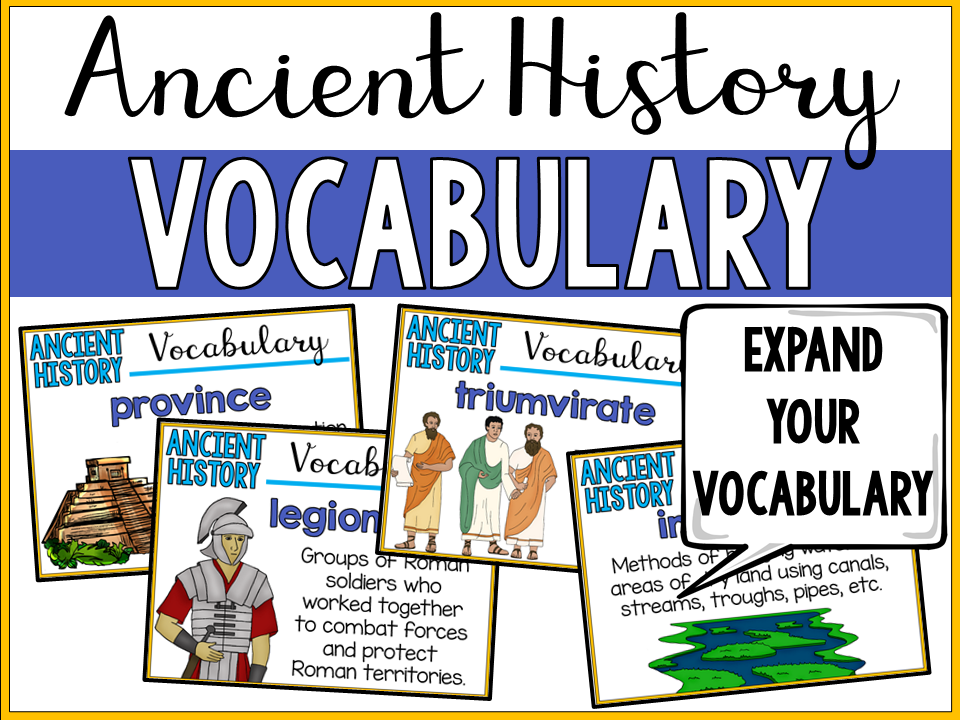
The Ancient History Vocabulary Bell Ringers are the perfect companion to the Ancient History Interactive Notebooks as they use key terms chosen from the concepts covered in the INBs! Of course, the vocabulary words aren't specific to those INBs and are based on typical concepts covered in Ancient Civilizations courses in middle school and can be used separately from them. On the days that I use these slides to introduce new vocabulary, students use the corresponding activity sheets to write the definition of the vocabulary word in their own words, draw a picture or symbol to represent the word and use the term in an original sentence. The more access and use students have of these new terms, the better they'll be able to grasp them and use them frequently within our unit.


There were some very interesting, thoughtful and wise people who lived in ancient times! Each of the slides in the Quote of the Day Bell Ringers resource has a quote from a historical figure in ancient times. I love choosing a person that lived during the time we are studying in school and asking the students the prompts on the slide: "What does this quote mean? Do you agree or disagree? How does this quote relate to an event in history or in your own life?" Students respond to each of the questions on their activity sheet for the day and keep it with their other bell ringer activity sheets in their binder. It's a simple activity that prompts students to think critically and deeply about a historical quote. It also gives them an opportunity to make a personal connection of use higher order thinking skills to link it to a particular event in history.


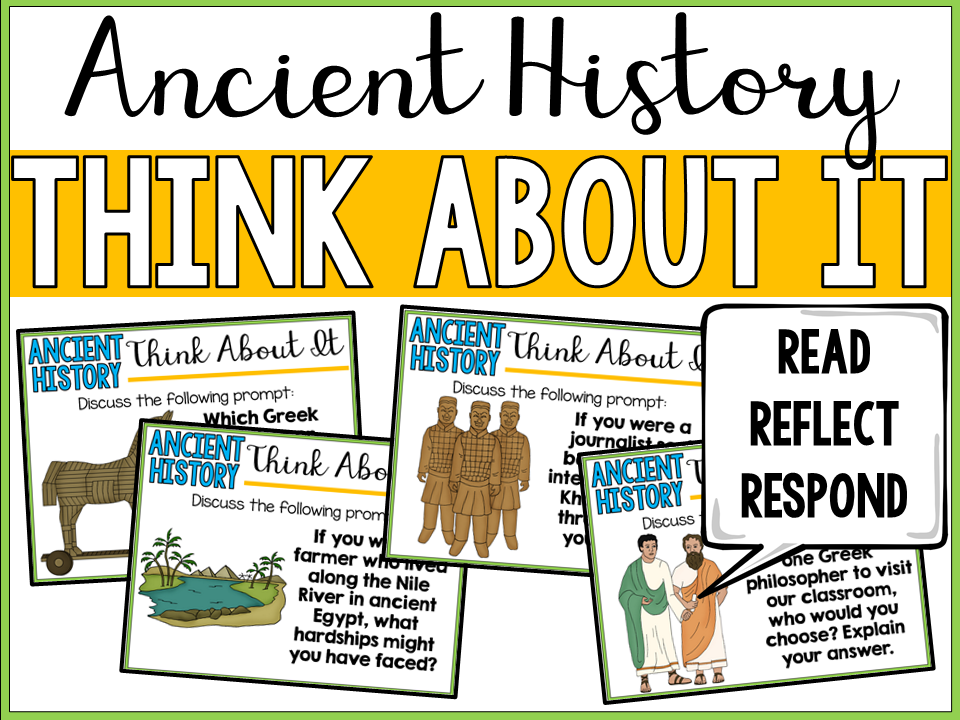
I LOVE critical thinking questions, don't you? Each slide in the Ancient History Think About It Bell Ringers resource poses a question that prompts students to think critically about a concept related to ancient civilizations. Some of my favorite questions are those that prompt students to imagine that they've traveled back in time to see or experience something. They love thinking about history as if it's alive around them! The response sheet for the days I use these questions asks them to summarize the question before responding. There's plenty of room on the response sheets for students to record their thoughts and I always ask some students to share their thoughts to the prompts.


As much as I love constantly engaging my students in historical content in new ways, I also value time spent on self-reflection and goal setting. The Growth Mindset Bell Ringers are a perfect way to end the week. Each slide prompts students to take a few minutes to reflect, write, make goals, problem-solve and track their growth throughout the year. 

Each of these activities includes 40 slides - enough for the entire school year! In the four that pertain the ancient civilizations, questions about the following regions are included: Early Humans, Mesopotamia, Ancient Egypt, the Israelites, Ancient Greece, Ancient Rome, India, China and the Americas.


If these bell ringers look like the perfect addition to your classroom routine, consider saving some money and purchasing the bundle!

Happy Teaching!


Monday, October 2, 2017

Reflection Connection: October


Now that it's October, we've settled into the rhythm of the school year. Classroom expectations have been established, we know all our students' names and half of our year's supply of pencils is already missing. :) The first weeks of school jitters are behind us and new challenges rise to confront us on both personal and professional levels. This month, let's reflect on those challenges we're facing and create an action plan for how we can solve those issues.

Entry 3: What challenges are your facing in school? What is your action plan for solving these issues?

My Response: One challenge that I'm currently facing is finding effective strategies to keep students' work organized - primarily for those who seem to lose everything! I've developed a binder organizational system, post homework and assignments in my classroom and online as well as work with those students on an individual basis. Somehow, though, a few students still seem to lose work despite all my efforts! Does this happen to you? What is your strategy for helping those students?

One policy I'm going to try this year is binder checks. I'm hoping it provides an extra incentive for my kiddos to stay organized while at the same time setting up a system that keeps me routinely checking on their organizational skills and offering assistance when necessary.

Your turn! What challenges are you facing and what is your plan of action?

Tuesday, September 19, 2017

Elementary Classroom Management Strategies That Still Work in Middle School


Developing a classroom management plan in middle school can be challenging, to say the least. Kids are growing and changing so fast at that age and it's difficult to judge which strategies will work best for kids in 6th, 7th and 8th grade.

You might be surprised to hear that middle school teachers can still use some of the same strategies seen in elementary classrooms, with a twist, of course. Here are a few ideas that my colleagues and I have used to create a positive, safe learning environment for our students:

Hand Signals

If you've ever been near an elementary classroom, I'm positive you've seen a teacher use hand signals to refocus students. Kids can use them to let the teacher know what they need. The same idea works well in a middle school setting as well. I've used hand signals to ask the students to be quiet and my students use them to signal a bathroom break. These nonverbal cues are efficient in saving time. How often have we walked across a room to answers a student's question only to find out that they wanted to use the restroom? A hand signal saves me time and I can nod my head to grant their request across the room while working with another student. 

Sticker Chart

Bear with me, here. I know what you're thinking..."Sticker charts in middle school? No way." I'll partly agree with you. While some groups of students would find it juvenile, it may be just what you need to inspire your unmotivated kiddos. I've worked with small groups of students that were failing school. They were unmotivated, lacked support outside of school and were often removed from the classrooms due to behavior concerns. When they came to my classroom, it was my job to motivate them to complete their work. Challenging? Y.E.S. So I brought out a simple little chart with 4 rows, 5 boxes per row - one for each day of the week for about a month. Each day a student was positive and productive, I put a sticker in the box. At first they scoffed at the idea. When their peers started earning small treats and prizes (a bag of chips, a small candy, etc) after getting 5 stickers, suddenly it became very important to earn a sticker each day. I couldn't believe it! These kids transformed in front of my eyes after a few weeks all because of a daily sticker...in middle school. Miracles happen, people, and we all ended up having a pretty good year!

Voice Levels

In elementary school, you'll see teachers with a chart of voice levels and colored dots to indicate what volume the kids should use when completing different activities. I've used this with much success in the classroom. The most common voice level charts I have seen have 4 levels: silence, whisper, normal voices and presentation voices. If you write your daily agenda on the board, it's super easy to stick a colored dot next to an activity so that the students understand what's expected of them during that time. This behavior management strategy is a keeper for me.

Marble Jar

The marble jar is an age-old strategy that allows your class to work as a team to fill the jar. Whenever someone does a good deed, goes above and beyond to help a fellow classmate or the class as a whole has a particularly good day, I add a marble to the jar. When the jar is full we have a little celebration! I fully believe in creating a positive atmosphere in the classroom so I never take away marbles. Those were hard-earned and they should be proud of every single one. 

Table Points

If your students thrive on a little friendly competition, starting a system of table points is a fun way to keep groups on task and accountable for their behavior. This is a fun strategy to use at the end of the year when they're getting a little (ok, a lot) excited for summer and have trouble remembering your classroom expectations. It works similar to the marble jar idea. Each group is awarded points based on individual and group behavior. As they reach certain point milestones, they receive little rewards! The rewards can start off simple (first group to leave the classroom) to more complex (homework pass) as they earn more points. You can even go to the dollar store and pick up little prizes or treats. Middle school kiddos love those little surprises! 

I hope you find some of these strategies useful in your classroom. Middle school is such a fun age to teach and your classroom can have a positive and uplifting atmosphere for your kids to express their ideas while they learn and grow together.
 
Happy Teaching!